THE prospect of rain over large parts of northern Australia over the next week has slowed direct consignment slaughter cattle offerings, with some Queensland processors raising cow offers this week as a result.
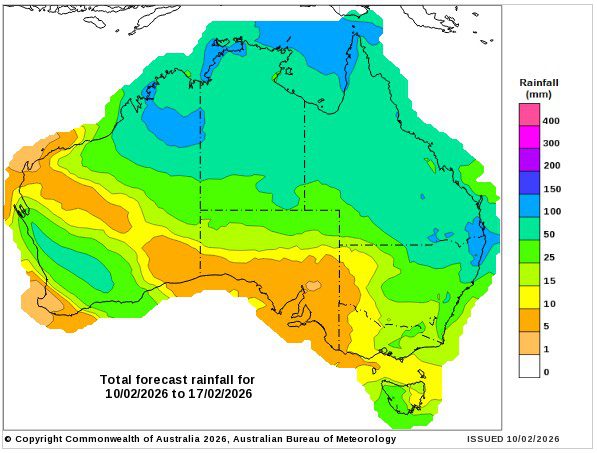
As can be seen in this BOM map, large parts of Queensland, the NT, Central Australia and parts of northern NSW are forecast to receive 50-100mm over the next seven days (aqua shading). If it delivers as forecast, it would alleviate some producer concerns, having watched paddocks rapidly dry-out during record high January temperatures and low summer rainfall since December.
It’s evident that some producers in the northern half of the continent will wait to see what the current influence delivers, before making turnoff decisions heading into autumn.
However with the A$ now stubbornly above US70c in value, it’s looking increasingly likely that export slaughter cattle prices will come under pressure in the north, as supply starts to gather pace.
Queensland processors’ phone have gone quiet over the past day or two, Beef Central has been told, as suppliers anticipate picking up some relief. Any general rain could push back bookings by a month or two, in an early-season period that was shaping up as likely to deliver cattle sooner, rather than later.
After signs of some softening in Queensland over-the-hooks grid offers a fortnight ago during the peak of the heatwave period, some cow grids in the northern state have lifted 20c/kg again, back to levels seen in mid-late January. Some large export processing businesses are yet to offer formal priced quotes this year, offering space bookings only with price to be negotiated closer to processing date. Those bookings are now out to March week one.
Other southern Queensland operators have grids on good quality heavy cows back up to 750c/kg this week, up from 730c earlier. Heavy grassfed ox four teeth are quoted this week at 830c/kg, with 10c more available on some grids for no HGP.
Plants in Central and Northern parts of Queensland are still struggling to fill kill rosters this week due to local logistics problems, with both grain and grass cattle from further south continuing to be shipped to fill holes in rosters.
Some over-the-hooks grids in Central Queensland – typically 10-20c behind operators in southern Queensland – are pretty much on par this week.
Already there are signs of southern processors pressing north to secure slaughter cattle again, just as they did for long periods last year. Most of that activity has been via the paddock, apparently, but some saleyards have already seen southern buyers at the rail.
For ‘special’ cattle, Certified Organic steers 0-6 teeth in southern Queensland were quoted at 930c/kg this week, close to their record highs seen during the post-drought shortage back in 2022.
Forward grainfed contracts
Forward contracts on grainfed ox for southern Queensland kills in May were quoted at 855c/kg this week, the same as April delivery, but up from 845c for March delivery, and the low-point of 820c for February. What’s becoming clearly evident is that there are few, if any, HGP-free grainfed forward contract offers in the market, given China’s decision in 1 January to restrict Australia’s tariff-free exports this year to 205,000t. Those offers used to typically be 30c/kg apart.
Direct consignment offers in southern states remain reasonably stable.
A southern NSW export plant was this morning offering 820c/kg on no-HGP four tooth grass ox, and 740c/kg on best cows.
Export processors in eastern parts of South Australia were showing 840-860c/kg and 790c/kg on steers and cows this morning, respectively. Angus MSA steer 0-4 teeth in one SA grid declined from 900c to 880c/kg this week, with MSA Angus cow 800c/kg, back 20c.
There were few attractive killable cattle in southern saleyards over the past few days, processor contacts said.
There was no weekly national slaughter report available by the time this item was posted. Results will be added here when they arrive.
Saleyards trends
While saleyards numbers have eased in some centres early this week, the general price trend was down on slaughter types.
Gunnedah sale this morning yarded 2750 head, down 750 on last week. Any price changes were mostly quality related. Heavy yearling heifers to feed sold from 348-457c with those to the wholesale meat trade at 398-460c/kg. Bullocks sold from 420-455c/kg. Grown heifers to processors sold from 368-420c/kg. Lightweight plain conditioned cows to processors sold from 280-344c, heavy score 2 cows sold from 300-359c/kg. Good heavy cows sold from 350-378c/kg.
Wodonga yarded 1100 this morning, down 700 on last week. The quality of the yarding was very mixed across all classes, with demand fluctuating around quality. Heavy steers and bullocks suitable for processors were in short supply, selling from 410-480c/kg. Heavy cows were well supplied and demand strengthened. The bulk of the heavy cows were firm to a few cents dearer making from 361-392c/kg. Leaner cows D3 types under 520kg were mixed selling from 338-360c/kg.
Naracoorte yarded only 964 this morning, down 33pc on last week. The regular buying group attended and operated in a market that ranged a few cents either side of firm on last week’s levels. The grown steers sold from firm to 5c/kg stronger with the best of the grown heifers 5c/kg dearer. Cows mostly eased from 5-10c/kg.
A preliminary Roma report this morning (full report appears tomorrow) indicated a substantially larger yarding of 8475, up 1600 on last week. Grown steers 500-600kg made to 480c/kg, with bullocks +600kg to 440c/kg. Cows were yet to sell.