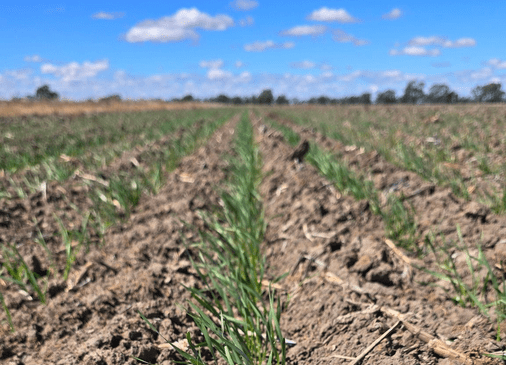
A dryland crop of Illabo wheat sown for grazing after substantial rain in late February. Photo: Jeremy Morton, Moulamein
GROWERS in the northern region have clamped down on selling amid very dry conditions, which further lifted prices for wheat and barley last week.
In the south, limited export business, the urea shortage, and an early start on winter-crop seeding have quashed grower interest in selling wheat and barley.
Most of South Australia, Victoria, and southern New South Wales have had enough rain to allow growers to start planting grazing or dual-purpose crops.
Cash crops, including canola, will be planted from Anzac Day, and most growers are looking at a reduced yield outlook based on the expense and scarcity of urea.
| Apr 2 | Today | |
| Downs barley | $418 | $420 |
| Downs SFW | $403 | $410 |
| Downs sorghum | $355 | $352 |
| Mel barley | $352 | $342 |
| Mel ASW | $375 | $368 |
Table 1: Indicative prices in Australian dollars per tonne.
Dry shapes northern ideas
Growers in parts of southern Queensland and most of northern New South Wales are cutting back their winter-crop planting intentions based on little to no subsoil moisture coupled with expensive input costs.
From west of Moonie in Qld down to around Coonamble in NSW and east to the Liverpool Plains, many growers are unlikely to plant a winter crop unless they get 100mm or more of rain over this and next month.
“It’s pretty quiet; we’re lacking a lot of liquidity,” one trader said.
“Growers I’ve spoken to out west are not going to punt on a crop.”
“If urea was $700 a tonne and not $1400, and fuel was $1.60 and not $3.25, and they got rain, they might change their mind.”
New-crop trading has started, with January wheat changing hands at $425/t Downs, and barley bid at $410/t.
Volume may well come from 2025-26 grain stored on farm.
“Those western growers have a lot of wheat held on farm; that’s their drought hedge.”
If growers get less than 100mm, barley or chickpeas seem the likely crop, barley because of its appeal to local lotfeeders, and chickpeas because of its ability to be grown without applied nitrogen.
Consumers are generally seen as covered in the current quarter, but have some open positions for the following.
“On the east coast, the grower must hold all the length.”
Gunnedah-based agronomy principal Jim Hunt of Hunt Ag Solutions said growers’ situations with urea on farm varied, and lack of moisture was the overarching limiting factor.
“We’ve got no profile for winter crop,” Mr Hunt said.
“A lot of people have got some early orders in, but they’ve only got a fraction of what they need.
“They’re in two minds about what to do with that investment.
“There are some discussions around on-selling it…or putting it in the ground for the summer crop.”
He said growers have generally not secured all their DAP and MAP for planting a winter crop.
“They’re uncertain about sowing full stop.
“We’re going to need 100mm in a lot of cases to match up the sowing moisture with profile on long fallow.”
Mr Hunt said barley, with its wider planting window, lower input cost, and better water-use efficiency was looking like a more attractive prospect than wheat, and canola was not likely to take up much area in these dry conditions.
“We’re nearly at the stage of putting a line through canola.
“We’re drier than most districts; our last decent rainfall event was in November.
“Chickpeas are still on the cards; we generally double-crop them into sorghum stubble, but we don’t have the moisture at this stage.”
South busy sowing
In the south, buoyant livestock prices and recent rain have many growers making an early start on planting with grazing or dual-purpose crops.
Peters Commodities Wagga Wagga-based trader Peter Gerhardy said business was “ticking along”, but at much lower values than the north.
“If fuel today was like it was in January…every man and his dog would be taking barley to Queensland,” Mr Gerhardy said.
Traders have said eastern Australian exporters cannot compete with Western Australian fob prices, and wheat is therefore buying little interest in the export department out of northern and southern ports.
However, barley business is being done in modest amounts, and has recently traded delivered Goulburn Valley consumer at $335-$340/t.
Mr Gerhardy said growers have ratcheted back their yield expectations based on the urea rather than the seasonal situation.
“Target yields won’t be as high; if they normally look at growing 6-7t/ha of wheat with 200kg of urea, they might be saying…we’ll put on 100kg and target 4-5t.
Despite the expense of urea and fuel, and uncertainty about urea supply, Mr Gerhardy said growers are looking forward to growing a good crop this year.
“The sentiment’s not too bad.”
However, some growers are intending to plant a below-average area to cash crops this season.
“There are extra lambs or cattle being held, and I get three or four phone calls a week from people saying they are going to drop off 500 acres from their cropping area.”
Grain Central: Get our free news straight to your inbox – Click here