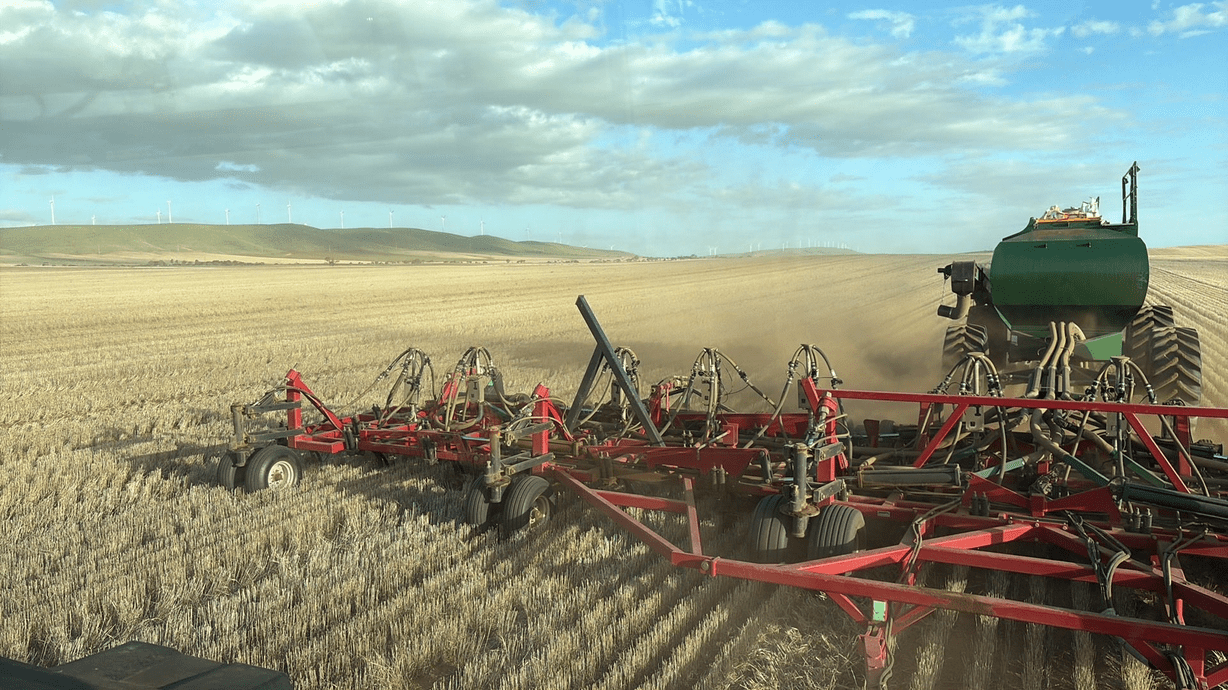
Despite high fuel and fertiliser prices, plenty of farms across southern Australia have started planting winter crops including canola. Photo: James Venning, Bute, SA
FEEDGRAIN values firmed last week as high fuel prices stymied sales to port precincts and pushed business into up-country sites.
In the south, growers have started planting their winter crop, and are hard-pressed to find a reason to deliver grain to ports or capital cities without the assurance of bringing home a backload of urea, now in limited supply due to conflict centred on the Persian Gulf.
In New South Wales, much of the state to the north and west of the south-west slopes remains dry, and mixed farmers outside the summer-cropping regions are concentrating their efforts on livestock as they wait for soaking rain.
In Queensland and northern NSW, the need to top-dress winter crops grown in heavy soils means plenty of growers are considering fallowing until spring, when they can plant a summer crop, hopefully with cheaper and more plentiful urea.
| Current Mar 26 | Today | |
| Downs barley | $410 | $418 |
| Downs SFW | $403 | $403 |
| Downs sorghum | $350 | $355 |
| Mel barley | $345 | $352 |
| Mel ASW | $365 | $375 |
Table 1: Indicative prices in Australian dollars per tonne.
Warehousing sales lift in north
Volume sold out of warehousing has lifted in the past week to counter grower reluctance to sell grain stored on farm amid shaky prospects for winter-crop planting.
While most of the Darling Downs has had good rain in recent weeks, the outer western Downs and much of NSW has limited subsoil moisture.
Growers across NSW and into Qld are hoping for solid rain by May to make a timely start on winter-crop planting; if it does not materialise, they can opt for more grazing, a summer crop, or low-input winter crops.
The area in question broadly runs from Condobolin to the Newell Highway, and north across the Qld border to the west of Moonie.
Clocking this dryness, and the impact of expensive fuel, some feedlots have in recent weeks extended their coverage out to September-October, when new-crop cereals should become available.
Knight Commodities Goondiwindi-based broker Gerard Doherty said buying out of depots has ramped up, and the market has “been well engaged on both sides”.
Highly variable subsoil moisture levels across the north are a factor.
“We’ve got an enormous amount of discretionary area that’s dry, but because of the cost of diesel and urea, guys are holding stock on farm,” Mr Doherty said.
New-crop trade remains illiquid, based on uncertainty about not just the season but on input and fuel pricing too.
“It looks like $400 a tonne for SFW January is possible.”
Mr Doherty said milling interest on H2 wheat was evident in Brisbane, but expensive fuel had trucking companies more interested in carting locally.
“If you can get $380/t ex farm Moonie, why would you chase an extra $10 to go to Brisbane?
“Premiums are not enough to go down the Range with white grain.”
Sources have told Grain Central that sufficient fuel for weed spraying and planting is turning up across the grainbelt, but urea to follow planting fertiliser is in short supply.
However, some is working as a backload on grain coming into Brisbane.
Darwalla Milling feeds manager Gary Heidenreich said southern Qld delivered grain markets are volatile, based on fuel uncertainty rather than fluctuating global grain values.
“A lot of freight companies are too afraid to commit to a freight rate, so traders and brokers don’t want to commit to a price.
“We’ve seen bids go up $5 or $10 in a day, and wheat and barley are up there on level pegging now.”
Darwalla is a poultry producer, and Mr Heidenrich said the relative flatness of the sorghum market means they are “starting to try and put a bit of sorghum” of varying grades into their rations.
South gets moving on vetch
Widespread rain over recent weeks has kicked off a solid season for the south.
However, its fuel and fertiliser supplies are no more secure than the north’s.
Many southern cropping operations also run sheep, and vetch is being planted across southern Australia either as a sheep feed, or as a brown manure crop to protect soil over the summer months.
“There’s more vetch going in than anything else,” Pinion Advisory Horsham-based broker Andy Brown said.
Urea prices appear to have stabilised at around $1400-$1450/t ex port depot, around 65 percent up from its values prior to the Iran-based conflict breaking out on February 28.
However, planting intentions are tipped to undergo only minor changes, although in-crop nutrition may be pulled back for all crops bar canola.
“The majority will stick with their rotations.”
In the Mallee, the wheat-barley-pulse rotation is popular, which means growers planting wheat may rely solely or partially on nitrogen built up in the pulse phase.
Mr Brown said buyers were wanting to book grain as far out as July, but growers were only interested in selling one week out because of the uncertainty around fuel pricing, and limited opportunities to backload with fertiliser from port.
“We’re selling more week to week at this stage.”
In his weekly report issued on Monday, Clear Grain Exchange managing director Nathan Cattle said a stronger Chicago wheat market and weaker Australian dollar helped buyers manage the risk of purchasing grain from growers at better prices.
This saw domestic end users step in last week to secure more cover, possibly due to prices looking more supported and growers about to start seeding.
“The result was buyers being able to crunch their numbers and bid on firm offers at higher prices than growers may have seen elsewhere,” Mr Cattle said in his report.
‘The number of buyers searching and bidding for Australian grain through the exchange remains high and is an indicator of demand and support for prices.”
“Grain was regularly trading at better prices than best published bids or cash prices.
“Lower-grade wheat was trading at much higher prices than best cash prices indicated early in the week through central NSW, with appetite for those grades fading later in the week.”