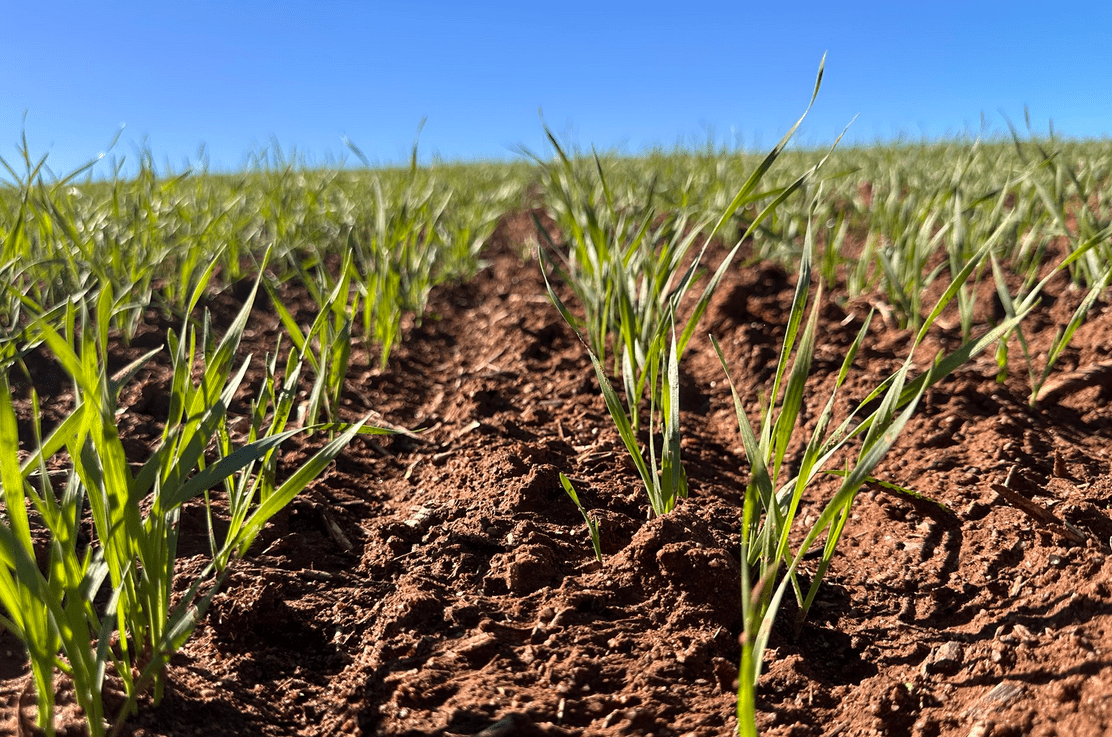
A crop of dual-purpose Illabo wheat sown mid-March is off to a strong start in the Young district, on the south-west slopes of NSW. Photo: Growmore Agronomy Services
GROWERS scattered across Australia are getting an early start on sowing thanks to recent rain, and despite uncertainty about fuel and fertiliser supply and pricing brought about by the war raging between Iran and US-Israeli forces.
Seeders are already out in force in parts of South Australia and Victoria, and mixed-farming operations planting dual-purpose or grazing crops like vetch are leading the charge.
Growers generally have fuel and fertiliser on hand for seeding, and while uncertainty is high on inputs post-emergence, rain in February and March has given growers in some parts of SA and Vic their best start in years.
While uncertainty about post-seeding fuel and fertiliser pricing and availability is palpable, so is optimism that rain always brings.
Some Western Australian growers are also making an early start, as are mixed farmers in central and southern New South Wales, where subsoil moisture levels vary greatly.
In southern Queensland and northern NSW, many growers need good rain to fill the subsoil moisture profile ahead of the main winter-crop planting window opening next month.
If sufficient rain does not fall, they have the option of planting a summer crop in spring, when hopes are high that urea and fuel prices will have softened.
Peter Tuohey, Terrick Terrick, Vic
In northern Vic, Peter Tuohey started his planting program on the weekend with vetch.
“We had one of our best earliest breaks – 120mm of February-March rain, so it’s really set us up with a full profile,” Mr Tuohey said.
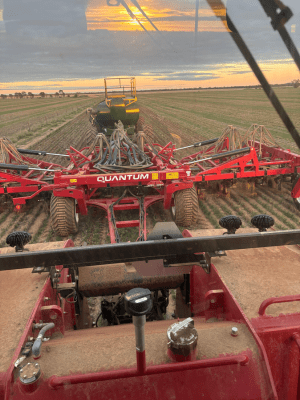
Sowing vetch on the weekend at Terrick Terrick in northern Victoria. Photo: Peter Tuohey
Mr Tuohey and family run 1000 Merino ewes, and plan to plant 500ha of vetch, which has the bonus of having nil fertiliser requirement.
“We’re spring lambers and…it’s the mainstay for our sheep.
“We plant vetch as part of a program; it’s for sheep feed, and we spray it out in spring to save moisture and reduce weed build-up.
“We can cut it for hay or graze it.”
After the vetch is in, they will plant more than 1000ha of canola, plus around 800ha each of wheat and barley, and 120ha of field peas.
Mr Tuohey said he has enough fertiliser on hand to plant the winter crop, plus a little, and the expense and scarcity of fuel and fertiliser has not altered their rotation.
“We’ll stick to what we’re doing.
“Most of us plan our crops 12 months ahead and…we’re all facing the unknown with prices.
“Costs are going through the roof, but I’m not sure that many farmers will cut back.”
“They certainly won’t be putting in extra paddocks; if it’s marginal [country], they might drop it.”
Urea prices appear to have stabilised in eastern and South Australia at around $1400-$1450 per tonne.
After that, with cereal prices where they are and with canola holding strong at around $800/t, Mr Tuohey feels urea demand may prove to be elastic.
“If it gets to $1500, people will say: You know what? That’s just too dear.”
James Stacey, Strathalbyn, SA
At Strathalbyn in SA, James Stacey and family will be planting around 1000ha of crop, including 200ha under irrigation.
Being only around 70km from Port Adelaide, their farm has not had issues accessing fertiliser or fuel.
“We’re still going to plant crops, but some of them will be used for grazing rather than taking them through to harvest.”
Those crops for grazing are expected to account for around 100ha, and will help support their 900 Merino lambs and around 1200 crossbred lambs.
“We’ve doubled our sheep flock in past five months because the crossbred lamb job is pretty good.”
The wool market is also firming, partly in response to heady crude oil prices as a result of the Middle East conflict, and the flow-on to synthetic fibre production.
Mr Stacey does not see himself as being in the market for urea for the farm’s dryland crops.
“Starter fert has not been an issue, and we’ll go in with our normal rates.
“We have pretty much resigned ourselves to not putting urea on dryland grain crops…so there’s 60-100 tonnes of urea we won’t be using.”
“If the forward price of grain was $400/t, we might change our mind.”
However, it is currently more like $320/t in SA, and growers have started to baulk at urea priced at around $1400/t depot.
“There’s a point where there’s demand destruction; I sell hay, and I know that.”
Michelle Bammann, Clare, SA
Ground Up Agronomy principal Michelle Bammann has clients in SA and WA, and said they generally have the fertiliser and fuel they need to plant.
She said growers were dealing with the mixed messaging of what for many is their best start to the season in years, against expensive and limited fertiliser and fuel versus relatively flat cereal prices.
“This year’s got a weird vibe about it; it’s this ping-pong ball in your head,” Ms Bammann said.
“Most of my growers have had 100mm plus of rain for March, and they’ve got a full profile of moisture, but what about the cost of fertiliser and fuel?”
Barley appears to have a better gross margin than wheat in WA, where many growers chase protein in noodle categories.
Ms Bammann said the reverse looks like the case in SA, where a greater range of segregations makes it harder to hit targeted specifications.
“Most of my guys aren’t changing at all; we’re on a pretty strict rotation.”
However, there appears to be a minor swing out of lentils and faba beans for feed legumes, namely vetch.
“Sheep are bringing phenomenal money…and we can control grasses really easily in vetch.”
Recent rain has created a body of feed that many mixed farmers are capitalising on with extra mouths.
“Young ewes that might have been sold are being put into lamb.”
Despite its appetite for nitrogen, Ms Bammann said canola area appeared unlikely to take a hit.
“Canola has been by far our best gross margin over the past 10 years, including drought years.”
She said growers can plant it after a legume to access stored nitrogen, and they have been keeping their own seed to plant open-pollinated varieties instead of paying for hybrids, and wearing the yield penalty.
Across Ground Up Agronomy’s SA client base, vetch is being sown, and will be followed by faba beans, then canola, all ahead of what is the traditional start date for winter-crop planting, Anzac Day on April 25.
“After Easter, I don’t think we’ll stop.
“Most of my guys haven’t got enough for a full post-emergent spread, but once the crop’s in, they’ll move again on urea and sulphate of ammonia.”
Recent rain also means weeds need controlling in what could be three knockdown herbicide applications, plus in-crop control.
Good news on inputs is growers and their suppliers are believed to have enough herbicide on hand for the crop now going in.
“At the moment, we just have to keep forging forward.”
Ms Bammann elaborated in a Ground Up Agronomy Facebook post dated March 27.
“The nitrogen cycle and the fundamentals of nutrition haven’t changed.
“With the recent rain and storms, there’s likely nitrogen in the system that we haven’t seen naturally in years.
“Do a soil test or two to understand what’s already there, and adjust your N accordingly.”
She also warned against “miracle” products that appear out of nowhere when people are under pressure: “There’s no silver bullet.
“If fertiliser is tight, consider cutting back hectares and focus on doing a smaller area well.
“Maybe take that paddock with ongoing issues out of the program this year and give it a clean up to go back in next season with good moisture levels.
“Most importantly, keep talking — to your mates, your neighbours, your family.
“Look out for each other and hang in there.”
Tim Starcevich, Salmon Gums, WA
In WA’s Esperance region, Tim Starcevich and family have had around 120mm of rain over the past seven weeks, and more is on the forecast for coming days.
The rain has enabled the family to make its earliest ever start on planting vetch to open their 5000ha planting program.

A vetch seed that germinated on March 27 within 24 hours of seeding on the family farm at Salmon Gums, north of Esperance in WA. Photo: Tim Starcevich
While some growers in and towards WA’s Great Southern region might do four top-ups with urea or liquid fertiliser post-emergence, the Starcevich’s rarely top dress.
“On fertiliser, we’re good; we don’t normally do top ups, but we did a little bit last year because the season was so good,” Mr Starcevich said.
After their 350ha of vetch is planted for brown manuring, the Starcevich family will move on to Denison wheat.
Barley will follow from around April 20-21 ahead of Scepter and Shotgun to complete the wheat program, and 750ha of field peas.
“We were thinking about dropping out peas and putting in canola, but with the price of fertiliser, we won’t be doing that.”
Wheat grown by the Starcevich family has registered protein of 9.5-14 percent protein, depending on the season.
Mr Starcevich got a fuel delivery today, and is expecting to be able to get the top-ups he needs in order to complete seeding and then do in-crop spraying.
Thinking ahead to harvest, Mr Starcevich is glad the family is now set up to use grain bags as a means of easing pressure on its road train, which can haul around 240 tonnes of grain per day to the nearest CBH sites at Salmon Gums or Grass Patch.
“We did grain bags for the first time last year which made a big difference; we’ve only got 250 tonnes of storage otherwise.”
Grain Central: Get our free news straight to your inbox – Click here