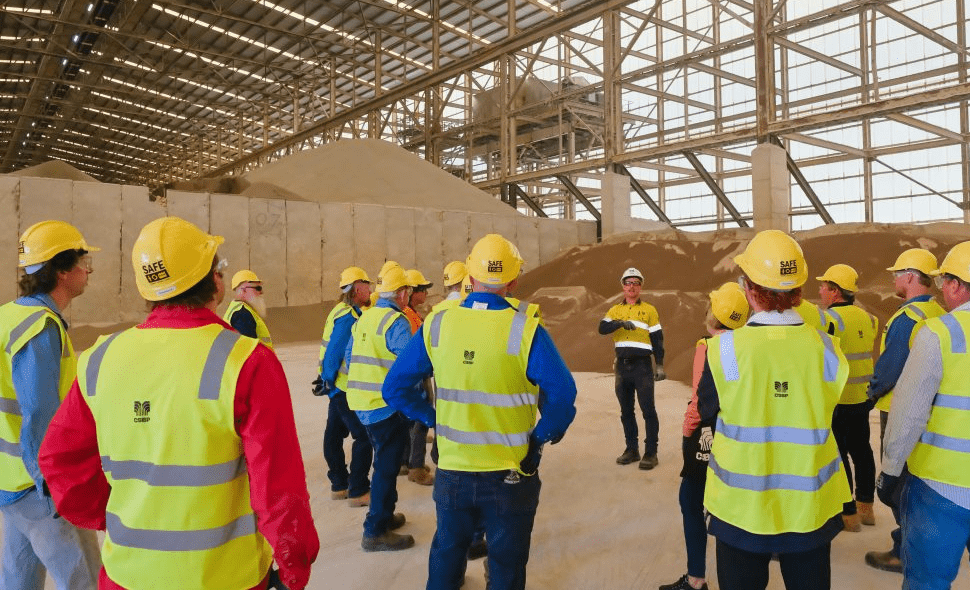
CSBP is one of WA’s major suppliers of imported and locally manufactured fertiliser which is available to growers at sites including its Kwinana Distribution Centre. File photo: CSBP
UREA importers around the world are navigating unknown waters as their main artery to global supply, the Persian Gulf, encounters a critical blockage at its gateway to the world, the Strait of Hormuz.
Amid ongoing hostilities between Iran and US-Israeli forces, urea manufacture and shipping out of the gulf looks to be halted for the foreseeable future, and CSBP has provided an update to what it is doing to shore up supply as best it can.
CSBP is a subsidiary of Wesfarmers Chemicals, Energy and Fertilisers, or WesCEF, a division of ASX-listed company Wesfarmers, and the update was delivered by CSBP sales strategy and reliability manager Ben Sudlow in a video filmed on Wednesday.
Along with Sumitomo’s Summit Fertilizers, Nutrien, and the grower-owned CBH co-operative, CSBP is a major supplier of fertiliser to growers in Western Australia.
CSBP manufactures liquid fertiliser using ammonia produced in WA and offshore, and imports urea and phosphates.
Mr Sudlow said CSBP was successful in securing some alternative supply of phosphates from the United States once it became evident some cargoes from the Persian Gulf would not arrive in time for planting.
“That product is now loading [and] on its way…and that is the kind of thing that will meet farmers’ needs for their ammonium phosphates for seeding.”
Mr Sudlow indicated that CSBP was pulling out all stops to up its domestic production.
“We’re going to manufacture more, we’re going to manufacture longer hours, and that ammonium phosphate’s coming, and we’re going to let it out all the way to mid-May as that product becomes available through manufacture and import.”
He said nitrogen rather than phosphates was “the big-ticket item”, based on 30 percent of the world’s traded urea coming out of the Persian Gulf.
“Ships can’t get in to unload, they’re closing urea plants, there’s ships that are loading in the Persian Gulf that can’t get out, and because of the energy that’s not going to some of the other South-east Asian places, they’re not being able produce urea as well.
“The net impact is structural decline in urea production and flow over the last three weeks.”
Mr Sudlow said CSBP “moved pretty quickly” to look at options beyond urea, namely urea ammonium nitrate and ammonium sulphate.
He said UAN was readily available out of China at “very competitive prices”, so CSBP moved to secure as much UAN as it could.
“We also looked at what the options were to buy more granular ammonium sulphate out of China.
“We moved to get contracts from China, which we did, and then just over a week ago, the Chinese Government, in protecting their own nitrogen market domestically, has gone and removed export license for UAN cargoes immediately.”
Mr Sudlow said China shipped some cargoes to CSBP and other customers in the two weeks that followed the announcement, but he said cargoes booked for the coming quarter are not assured.
“Therefore, we’re moving to see what alternative supplies of product we can get.
Mr Sudlow said CSBP was sounding out UAN availability in the US, Europe and Egypt.
“Those ones are being looked at and that’s an option we’re working through right now.”
Diplomatic assistance sought
Mr Sudlow said CSBP was in discussions with the Federal Government to see if it could “have influence in China” to get its government to allow some UAN to be exported to Australia.
These are part of broader discussions led by Fertilizer Australia, the peak body of which CSBP is a member.
“There is discussion around the Federal Government allowing Russian oil in, and we’re contemplating: Is there a way where we may be able to get Russian UAN, subject to the government’s advice that that would be okay in terms of tariffs/sanctions?”
Mr Sudlow said in the current environment, several countries have limited exports of their products.
“China has done it; they were expected to put urea back on the market [and] they’ve said no, we’re not exporting any more, like they’ve done with UAN.”
“There’s been reports that Russia has put an export ban on ammonium nitrate; they’re protecting ammonium nitrate for their local market, and other countries are now saying: right, we’re just going to hold urea internally, which is then further reducing the amount that’s available for the export market.”
Alternative sources for UAN
UAN is used by some growers in eastern and South Australia, and most growers in WA, who source it as Flexi-N from CSBP, and under other brands from CSBP’s competitors.
“A lot of the Flexi-N is out in farmers’ tanks now; in terms of seeding, most of it’s out there.
“We’re supplying March and April volumes at full contracts, so we’re pretty confident that…UAN for seeding is covered through…full tanks, plus what we’re going to deliver through into April.”
Mr Sudlow said CSBP was looking to increase manufacture of Flexi-N, subject to its facility’s production capacity to fill “a pretty significant shortfall from the Chinese export ban”, and the Yara Pilbara outage.
“That is reducing the amount of ammonia which is available to produce ammonium nitrate.”
Mr Sudlow said CSBP has sourced some granular ammonium sulphate from China.
“We will be making that available to sell fairly shortly.
“We’re taking a fairly cautious approach that until those ships load and sail, we’re pretty apprehensive to put those out on the market to sell on the event that China changes their mind, which is…quite possible.”
Urea values settle
In eastern and South Australia, urea prices appear to have settled in the past week at around $1400-$1450/t ex port depot, roughly $50/t above the WA market.
“We’re seeing retail prices now between $1350 and $1400 a tonne based on what we might be able to secure [from] a urea vessel today,” Mr Sudlow said.
“We’ve spent the last two weeks trying to get urea vessels and it’s been incredibly challenging, as some of those vessels that we might have otherwise expected are contracted to come out of the Persian Gulf.”
Mr Sudlow said the likelihood of them making their way from the Persian Gulf to WA in coming months appeared to be slim.
“We’re looking at what we can get from elsewhere.
“We do have some contract cargoes outside the Persian Gulf we expect to come into WA through April into early May.”
Mr Sudlow said the challenge now was sourcing cargoes for May-June arrival.
“They’re the ones we are working on now, recognising there’s still a lot to play out in the Middle East.
“We feel comfortable about the contracts we’ve got and the stock we’ve got here, and sailing here; we’re meeting our contracts that we’ve got on the books right now.
“Our job right now is to buy more cargoes.
“We’ll continue to work to get more urea cargoes to offer out to customers over the coming weeks so they can get some confidence around urea supply in the post-seeding application window.
Grain Central: Get our free news straight to your inbox – Click here