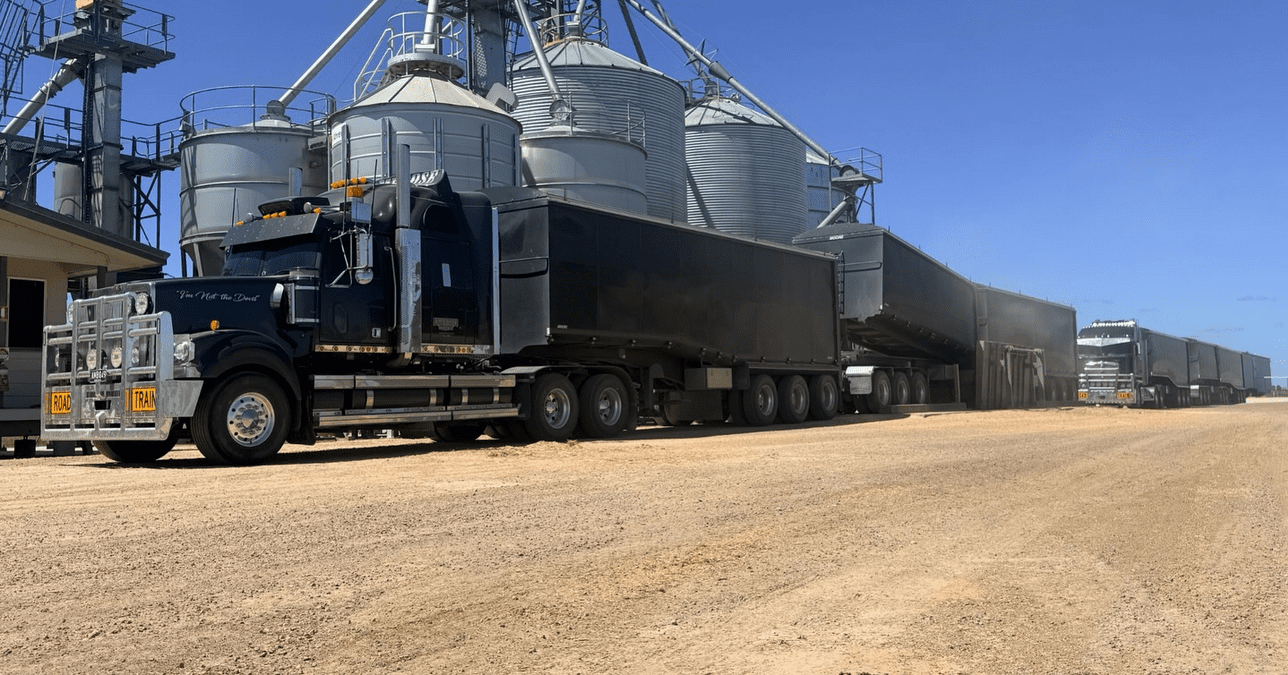
Grain from north-west NSW being delivered to a feedlot in Qld’s Condamine district this week. Photo: Ambrose Haulage
THE IMMEDIATE and projected impact of limited and expensive fuel and fertiliser prices has seen eastern Australian grain prices lift by up to $35 per tonne in the past week.
The rally has been greatest in the southern Queensland market, where consumers are said to be building stocks as a buffer against rising freight rates, and shrinking grower sales.
Across both the northern and southern regions, growers are talking about cutting their winter-crop area in response to diesel and urea prices, which continue to rise to the point where a full-scale plant is seen as uneconomic.
In the northern region especially, limited subsoil moisture is further reason for growers to temper their ideas about planting cereals in coming months, and turn their hopes to rain and lower fuel and urea prices by September for a summer crop instead.
| Mar 19 | Today | |
| Downs barley | $375 | $410 |
| Downs SFW | $375 | $403 |
| Downs sorghum | $350 | $350 |
| Mel barley | $343 | $345 |
| Mel ASW | $345 | $365 |
Table 1: Indicative prices in Australian dollars per tonne
Market hot for northern grain
Escalating fuel prices are hitting the north hard as some consumers up the ante to get themselves covered ahead of further hikes.
Ambrose Haulage managing director Jim Ambrose said the AB triples owned by the Goondiwindi-based business and hauling grain from north-west New South Wales to feedlots in the Condamine district are using $18,000 per week of fuel in three 1750-litre fills.
With the cost of diesel now at well close to $3.20/l, roughly double its price prior to the breakout of the Iran and US-Israel war, Mr Ambrose said the trucks now need to make $28,000 per week to break even.
“That truck is turning $19,500, so it’s losing $8000 a week,” Mr Ambrose said.
Many transport operators are speaking with their banks to reduce or delay loan repayments, and Mr Ambrose said government support is needed to keep trucks moving.
“During COVID, the government took the fuel excise off and brought in Jobkeeper.”
As yet, no assistance has been offered to road-transport operators.
“This dwarves COVID costs.”
Farmers, who are also feeling the pain of rising diesel prices, are doing their sums on the viability of planting a winter crop.
“A lot of my farmers are asking…is it even worth putting a crop in the ground?”
Traders say consumers have no choice but to pay more for grain to retrospectively cover escalating fuel prices being paid by transport operators like Ambrose Haulage, and to get grain out of growers’ hands.
Dry conditions in parts of the north are also fueling grower uncertainty about what or if to plant this autumn, as heavy soils need ample subsoil moisture to get cereal crops off to a good start, and in-crop urea to maximise yield potential.
Summer rain has been limited in parts of the north, and one trader said growers were looking at turning stocks from last harvest into a two-year income stream.
“Growers in southern Qld and northern NSW are saying…what we’re carrying now could be next year’s cash flow.”
For some growers, heavy debt will see them take a punt on making money out of winter crop including chickpeas, which require subsoil moisture but have the advantage of not requiring in-crop nitrogen.
Growers in northern NSW and into southern Qld are generally looking for 60-100mm of rain as the first step in making a decision about winter-crop planting, which will start around Anzac Day, provided rain falls in the meantime.
Across the wider region, growers are generally seen as holding half of last year’s harvest on farm or in warehousing, and are waiting for higher prices to cover current-crop and inflated new-crop input costs.
“Even if we didn’t have this war going on, the grower wouldn’t be selling.”
Green in south where lambs look good
Southern wheat and barley markets have also rallied this week, with wheat delivered Melbourne gaining around $20/t against only a few dollars at most for barley.
As with the north, stronger pricing on both grains incorporates increased fuel and therefore freight costs, rather than a strengthening in global values.
“The fuel game is playing a major role in pricing now,” Peters Commodities Wagga Wagga-based trader Peter Gerhardy said.
Rain in the past month has turned many parts of Victoria and southern NSW green, and declared ready in terms of subsoil moisture for winter crop.
Growers with livestock have already planted reasonable areas of oats, pasture and dual-purpose crops as they weigh up their options for the main planting window which opens around Anzac Day.
Riverina to port freight now sits at around $60/t, roughly double what it was before fuel prices started to climb early this month in response to the war with Iran.
The fertiliser shortage is also playing a role, with backloads hard to secure on grain deliveries.
Southern consumers are said to be in a more comfortable position than their northern counterparts, with many still calling in grain sold on a January forward spread.
Mixed farmers in Vic and central and southern NSW are already looking at dropping problematic paddocks out of their cropping program this year.
However, canola gross margins still look attractive, provided the crop can be planted early.
“I think cereals are going to cop a caning; all the costs are starting to outprice themselves,” Mr Gerhardy said.
Heavy export lambs this week set a new national record of $500 at Ballarat, and Mr Gerhardy said even at around $350 per head, lambs were an attractive option for mixed farmers.
“Turning off four or five of those per hectare is a darn site easier and cheaper than growing wheat for $300 a tonne.”
With nothing to say Riverina-port freight will not hit
One trader said the region has had “a great autumn break”, but the number of variables growers were weighing up around planting the winter crop were considerable.
“This freight issue is causing drama.”
He said growers were already taking about making this year’s cropped area smaller than last year’s, with marginal paddocks the first to be jettisoned.
The source said southern feedlots have been able to ratchet back their weekly grain requirements based on improved seasonal conditions, allowing backgrounding to higher weights in the paddock.
“The grass growth we’ve had lately has been phenomenal.”
Grain Central: Get our free news straight to your inbox – Click here