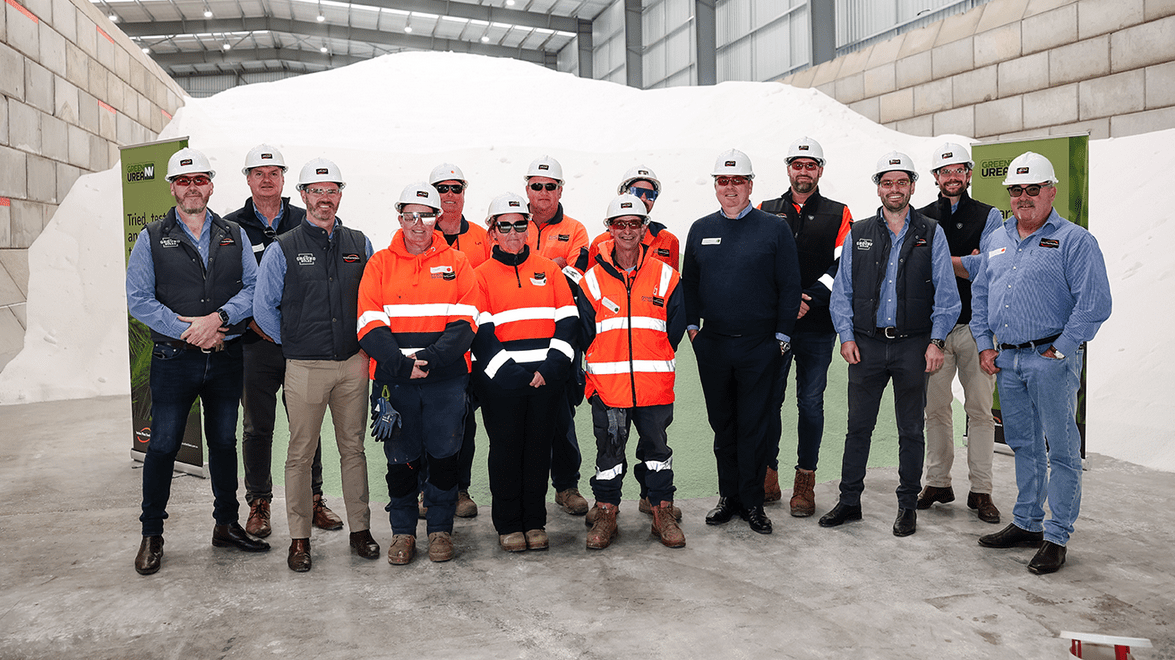
While sheds at port were regularly filled with urea to supply demand for top-dressing last year, this year looks like being a different story as the Strait of Hormuz remains closed to nearly all shipping. File photo: Incitec Pivot Fertilisers
THE closure of the Strait of Hormuz has throttled the supply of fertiliser to Australia as it enters its peak demand period.
Most growers are believed to have their fertiliser needs for planting covered, and are weighing up options which include sowing pasture, or low-input crops like pulses, barley and oats, or running more livestock.
It appears fertiliser importers only have two options: source what they can from outside the Persian Gulf, which typically supplies around 40 percent of Australia’s urea needs, and lean hard on the Federal Government as its peak importing quarter nears.
In Question Time in Parliament on Monday, Victorian MP and deputy leader of the National Party Darren Chester asked Minister for Agriculture Julie Collins what the government was doing to secure fertiliser for Australian farmers in the face of the Middle East conflict.
His question referenced a letter sent on March 17 by the sector’s peak body Fertilizer Australia to the government, which stated further shipping disruptions would have “catastrophic impacts on domestic agricultural output in the 2026 season”.
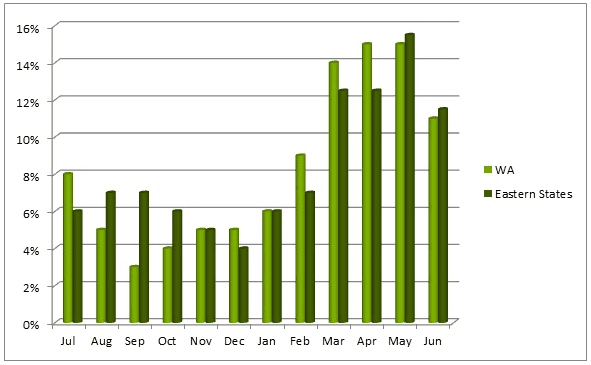
A guide to the monthly split of Australian fertiliser demand. Source: Fertilizer Australia
The letter’s suggestions included an easing of restrictions on fertiliser trade with Russia, including clarifying and streamlining pathways for Australian and international banks to “support legitimate fertiliser transactions”.
“It is noteworthy that fertilisers are not subject to sanctions in the United States, the European Union or the United Kingdom, although some jurisdictions apply tariffs,” the FA letter said.
“A temporary and narrowly targeted approach focused solely on fertiliser supply would help diversify sourcing options at a time of acute global constraint.”
The body has also called for a temporary easing of rules governing ammonium nitrate (AN) concentrations for on-farm use in order to increase availability of domestically produced nitrogen products.
“Australia’s current limit of 45pc AN concentration is materially lower than settings in parts of Europe, where blends between 70 and 90pc are permitted depending on product type.
“Carefully managed, time-limited changes could materially increase the effective supply of nitrogen available to farmers without compromising safety outcomes.”
Progress on home front
In response to Mr Chester’s question, Ms Collins said she had been working with Minister for Industry Tim Ayres to look at options for the sector.
“We have enough fertiliser either in Australia or on ships in terms of the initial cropping season and, certainly, we are getting a lot of input from farmers about fertiliser prices,” Ms Collins told the House of Representatives.
Ms Collins said the government had been working with the Australian Competition and Consumer Commission to ensure that “fertiliser is getting to the people that need it most”.
 “As a government, we are aware that some cargoes booked for Australia are delayed in the Persian Gulf and we continue to monitor it.
“We do source urea fertiliser from other regions and we are working with industry to seek alternative supplies in the same way that we are working with the ACCC and industry for fuel.”
“We’re in regular contact with Fertilizer Australia on how we might source more fertiliser as Australian farmers need it, and we have been doing the work to make sure Australian farmers can have certainty when it comes to future crops.”
FA has also asked the Federal Government to engage with China to ensure existing contracts will send some product to Australia.
“Australia plays a significant role in global food production and contributes to food security for key trading partners, including China.
“Framing this issue in terms of shared food security interests may help support continued supply flows during a period of heightened geopolitical tension.”
However, recent indications out of China point to no easing of its restrictions on fertiliser exports as it seeks to ensure sufficient supply for its own farmers.
On top of calling for continued government advocacy through diplomatic and international channels aimed as restoring “safe and reliable shipping access through the Strait of Hormuz as soon as possible”, the FA letter asks for a dedicated taskforce.
“A single, empowered point of contact within government would assist industry to navigate regulatory, trade, financing and logistical issues quickly and coherently, and would improve information sharing as conditions evolve.”
This appears likely, as earlier on Monday, the government announced plans to include fertiliser in a National Food Supply Chain Assessment, which is currently prioritising diesel as a crucial input.
Volume stakes high
FA is yet to issue a statement on the impact of the Strait of Hormuz’s closure on its members, but traded volume is said to have taken a hit which may well be outlined by ASX-listed Ridley at or before its final dividend announcement on August 20.
Ridley last year took over the Incitec distribution network, and its fertiliser business snapshot released March 10, said it had more than 45pc of the eastern Australian market and a “privileged domestic distribution network” of around 2Mt per annum.
Companies which manufacture as well as import fertiliser include Fertiglobe.
Based in Abu Dhabi, Fertiglobe last year took over the distribution network of Wengfu Australia, which handles a total of around 750,000t annually across eastern and South Australia.
Fertiglobe has plants in Algeria and Egypt which may still be producing and exporting, but the same cannot be said for its Fertil plant in Abu Dhabi, which produces 2.1Mt of urea annually.
Grain Central understands the Canadian-based Nutrien distributes around 1.5Mt each year across all states including Western Australia, where it competes with locally-based entities CBH, CSBP, and Summit.
Other importers include US-based Koch Industries, and Impact, part of the Swiss-based Ameropa agribusiness, and all the above-mentioned companies have been contacted for comment.
Australia is believed to have imported around 3.7Mt of urea alone in 2025, and its dependence on imports, which come primarily from the Middle East, was put starkly by Clime analyst Paul Zwi in his March 19 Quick Bites report.
“Australia’s dependence on imported fertilizer is substantial and growing,” Mr Zwi’s report said.
“In 2024, the nation consumed 8.7Mt of fertiliser valued at A$5.5 billion, with imports accounting for 7.9Mt, an increase of 38 percent on 2023, yet domestic production has declined sharply to just 1.3Mt, being only 15pc of total consumption.
“This heavy import reliance leaves Australia vulnerable to global supply chain disruptions.”
He lists Australia’s two dominant fertiliser types as being urea at 44pc of consumption, and monoammonium phosphate, or MAP, at 18pc.
MAP and diammonium phosphate, or DAP, are used primarily for winter-crop planting, and Australia in 2024-25 produced a total of 234,394t, around 14pc of the 1.7Mt used.
Grain Central understands around 80pc of grower MAP and DAP requirements are covered, with stocks either in the country or on farm, and at least one cargo bound for Australia is stuck in the Persian Gulf.
Relative price hikes tell the story: MAP is now trading at around $1300/t ex depot, up from $1170/t in late February prior to the Strait of Hormuz closing to most oil, gas and fertiliser cargoes.
In contrast, urea has been trading at around $1400/t ex depot since mid-March, up from $850/t in late February.
At least one supplier is believed to have notified its customers that 70pc of ordered MAP is assured, with hopes that the remainder can be filled in the required timeframe.
As Lachstock Consulting outlined in today’s market wire, growers already have a plan for cropping.
“Australian farmers are already responding ahead of winter planting, with some paring back wheat acreage and considering a shift toward oilseeds, pulses and barley, decisions that could weigh on global supply into 2027,” the report said.
Provided a timely break in the season comes, it looks like they will go big on canola, selling into a strengthening oilseed complex fueled by the Middle East conflict’s impact on global fuel prices.
Even before hostilities escalated between Iranian and US-Israeli forces, the global wheat market was having trouble justifying a big spend on urea from Australian growers.
In WA, area planted to noodle wheat, which has a minimum protein requirement of 9.5pc, may well drop sharply this year as growers uninspired by its price outlook opt for other crops.
Growers with a high debt-to-equity ratio may well opt to crop a reduced area overall this year, but others keen to capitalise on early rain, or with hefty repayments to make, are sure to snap up any urea that can make its way into the country at current rates.
Grain Central: Get our free news straight to your inbox – Click here