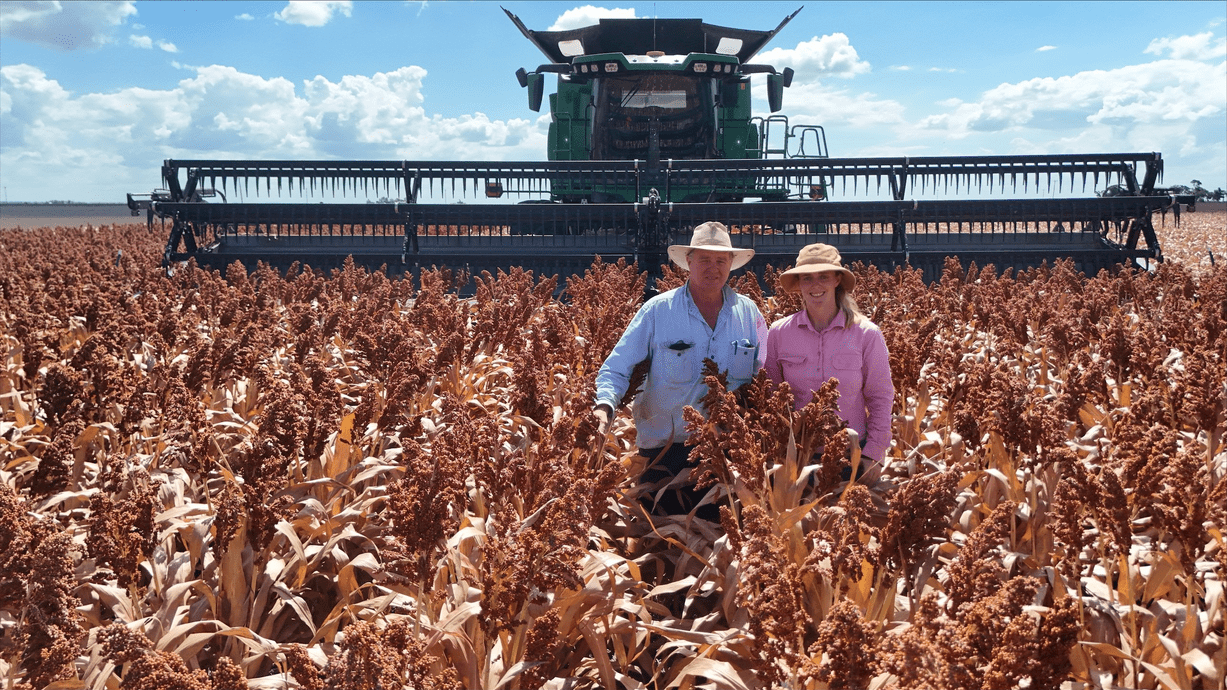
John and Chloe Crothers harvesting Maestro sorghum at 11-12t/ha on their at Pirrinuan on Qld’s western Downs earlier this month. Photo: Pacific Seeds
HIGH diesel prices are helping to jack up delivered grain prices as bids climb in a market concerned by the elevated cost of production for new-crop cereals.
Sorghum off the header is selling in reasonable volume, but wheat and barley remain hard to buy from growers, who are contemplating a reduced new-crop area to minimise their exposure to expensive prices and supply-chain issues for fuel and fertiliser.
Trade sources report some grain contracts are being written to include a ratchet clause which gives the counterparties some wriggle room on price based on the cost of fuel at the time of cartage.
| Mar 12 | Today | |
| Downs barley | $363 | $375 |
| Downs SFW | $363 | $375 |
| Downs sorghum | $350 | $355 |
| Mel barley | $343 | $348 |
| Mel ASW | $345 | $350 |
Table 1: Indicative prices in Australian dollars per tonne.
Northern prices jump
Feed barley and wheat prices have rallied $12 per tonne in the delivered Downs market in the past week to reflect rising diesel prices and subsequent difficulties in pricing freight beyond next week.
The stronger freight rates also reflect the difficulty some growers are having in delivering grain to port and backloading with fertiliser as stocks run down ahead of further cargoes arriving from ports outside the Persian Gulf.
 “The market’s up, and the reason is a bit of everything,” one trader said, adding that consumers were appreciative of the fact that transport companies need to pass on the cost of more expensive diesel.
Ambrose Haulage managing director Jim Ambrose said his fuel price has gone up from $1.67 per litre to $3 for next week, meaning the business is operating at a loss based on contracts written prior to the fuel price hike.
“How do we keep 37 people employed in this environment? That’s what I’m thinking about all the time,” Mr Ambrose said.
Traders report some major grain-trading companies and consumers are writing ratchet clauses into contracts which add a flexible component to pricing based on the cost of fuel used to transport the grain in question.
As a ballpark figure, Downs to Brisbane freight now costs around $35/t, up from $30/t two weeks ago, which is not enough to cover fuel at $3 per litre.
Without ratchet clauses, forward business is hard to write.
“They’ll only quote for this and next week,” one trader said of transport companies who have no certainty on diesel pricing as far ahead even as next week.
Feedlots continue to chase barley rather than switching to wheat, as often happens once the weather starts to cool down.
Trade sources report the Downs barley market has traded at more than $380/t in spot sales, which reflects its scarcity north of the border, while wheat has peaked at $380/t in limited amounts.
Robinson Grain trader Jock Benham said uncertainty around road-freight costs, delivery slots in a disrupted shipping environment, and also pick-up of fertiliser, have all helped to limit trade in the past week.
“Everyone’s trying to work out what freight we need to work on,” Mr Benham said.
“There are bids out there, but not too many offers.
“People would rather sell ex farm to port, but you’ve got to have the right delivery slots for that to happen.”
Much of Queensland has had good rain in the past week or two, but much of NSW remains very dry.
While that is not unusual at this time of year, it has growers in some districts thinking they will plant less, little or no winter crop once the April-June planting window opens
That decision is based on limited subsoil moisture at present for some, expensive diesel, and urea at $1250-$1400/t ex depot, up from $850/t or so in late February prior to the outbreak of hostilities between Iranian and US-Israeli forces.
In contrast, cereal prices have moved little since harvest to compensate.
“Some Central West growers are threatening to down tools for the season.”
Southern grazier demand vanishes
Recent rain across much of Victoria, South Australia and pockets of NSW has quashed demand from the grazier market.
With pastures growing, and dual-purpose or grazing crops already planted, Grain Focus managing director Michael Jones said livestock was a brighter option than cropping for some.
“The grazier market down here has vanished,” Mr Jones said.
On early crops like oats and dual-purpose canola, Mr Jones said growers could be just as likely to put them all into livestock as take them through to harvest.
“They’re not going to put all their urea under it now; if urea ends up costing $1500/t, they might say: ‘We’ll just chew it out’.”
Mr Jones said growers with grain left to sell are looking at the replacement cost, and generally not liking the numbers.
“They’re watching their costs go up, and asking themselves why they would be selling.”
Grain Central: Get our free news straight to your inbox – Click here