NEW South Wales prime lamb producer Isabele Roberts has been able to highlight the profit differences between two feeding systems with the unique carcase feedback system offered by Gundagai Lamb.
At a workshop last month, Ms Roberts showed the value in linking on-farm data and carcase data through electronic identification ear tags.
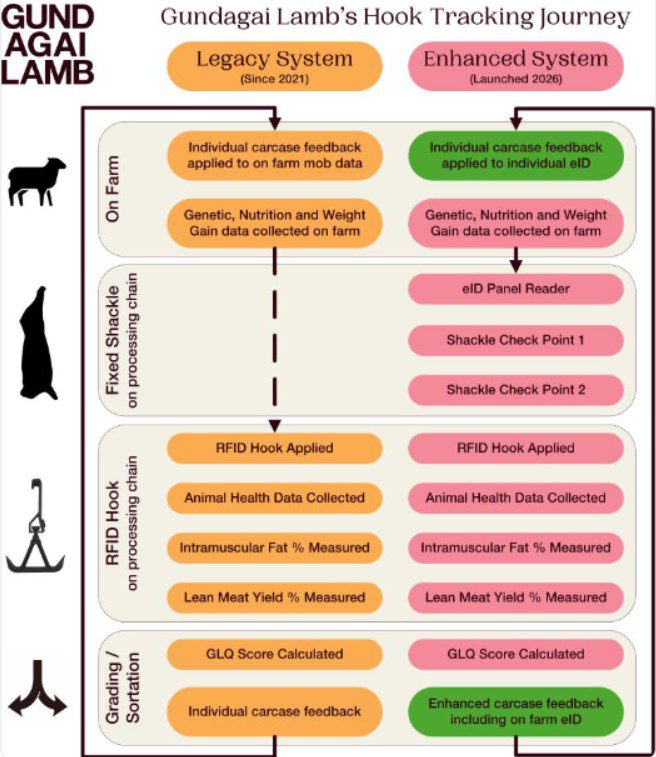
Gundagai Lamb has been providing individual carcase feedback including hot standard carcase weight, lean meat yield and intramuscular fat since 2021.
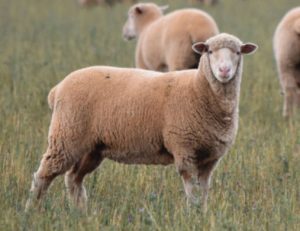
Ridgehaven lambs finishing on lucerne pasture.
From last month, it has provided enhanced individual carcase feedback by linking it to on-farm EID ear tags on lambs; the first Australian lamb processor to do this.
At the 24 March workshop, Ms Roberts outlined how she was able to determine a profit margin difference of $22.86/head (including an induction $/kg liveweight value) in a trial of Ridgehaven Poll Dorset-Merino cross lambs compared in paddock-based and feedlot systems. The sires used had breeding values for moderate growth and higher IMF.
In a LinkedIn post, Ms Roberts said the family’s business has been consigning lambs to Gundagai Lamb since 2021 and receiving individual carcase feedback on weight, lean meat yield, marbling (intramuscular fat) and animal health.
“That’s five years of data that guides us to understand genetic merit, adjust production inputs, get the timing right, appropriate selection of lambs, and how to get the best profits out of our prime lamb system.
“The big question is still around finishing systems and what (if anything) drives higher IMF%,” she wrote?
Ms Roberts outlined the late-January trial with 600 lambs of the same age and genetic base being backgrounded under the same conditions before being split them into two finishing groups.
One group was finished in a paddock situation of dryland lucerne pasture with an adlib feeder of oats/barley/lupins, and the second group in a commercial feedlot. The lambs were in the finishing systems for six weeks, grew at predicted rates, finished to fat coverage specifications and were transported to the processor on the same truck.
 Trial results
Feedlot group
Input direct costs $9.50/head/week
Daily weight gain 319g/day
Exit av. LW 57.7kg
Paddock group
Input direct costs $5.90/head/week
Daily weight gain 243g/day
Exit av. LW 59.6kg
The IMF average of the paddock group was 5pc, with 63pc receiving the GLQ5+ $bonus with a LMY average of 58.5pc. This compared to the feedlot group’s results of IMF average of 4.3pc, with 38pc receiving the GLQ5+ $bonus with a LMY average of 58pc.
The profit margin difference between the two groups was $22.86/head (including an induction $/kg LW value), with the paddock group being more profitable.
Ms Roberts said the trial showed that the flock’s genetics in this paddock system can create a consistent and higher IMF% level, at a lower cost of production and resulted in a higher $/kg HSCW lamb.
“We know how we did it, and we can do it again.
“And to the lamb industry as a whole?,” she asked.
“Knowledge empowers an industry to be proactive in production decisions, to focus on a specific production outcome, and add stability to the whole value chain.”
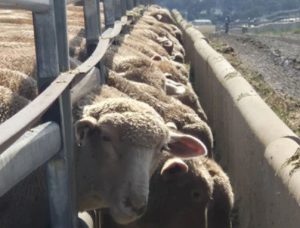
Ridgehaven lambs in the feedlot.
Ms Roberts said data descriptions of the carcase traits important for meat processors, and traits that ensure the consumer enjoys their eating experience, driving demand for lamb, and ultimately growing the market.
“As a producer, I want to know what I have produced so I can do better next time.
“Our production systems are planned and flexible; they have to be when seasonal variation is normal, and animal performance is affected by all sorts of environmental challenges, health impacts, nutrition and management decisions.”
Ms Roberts said the details of the feed fed the lambs is less important than the ability to link on-farm data and carcase data through EID ear tags and the technology in the plant at GMP so the significant difference in results and profit margin between the two finishing programs can be seen.
“If every producer had access to a production “report card” for their lambs, it opens up all sorts of possibilities for improvement.
“The feedback loop is not a new idea, just not one that is available to most lamb producers,” she said.
“I wanted to use the finishing feed trial as an example of information that can be used in production decisions for future consignments, and where the producer and the processor both get more value out of lambs.”
Gundagai Meat processors chief executive officer Will Barton said the ability to link EID tags through to carcase data at the plant was due to some brilliant work by NSW Department of Primary Industries and Regional Development project manager Tracy Lamb, SCL Group products manager David Wright and GMP supply chain manager Claire Marriott.
“So if you’re tagging on farm, you can now match your on-farm management decisions and genetics to exactly what that animal did at the other end.
“And if you’ve got something like Optiweigh running, you’re adding individual weight gain trajectory to that picture as well,” he wrote in a LinkedIn post.
“That means you can see which lambs converted feed efficiently and which ones didn’t.
“You can start to understand whether your genetics are delivering what you think they are,” he said.
“You can figure out whether the diesel and grain bills are worth it.”
The feedback developments at Gundagai Lamb now mean that each GLQ5+ lamb cut can be traced by chefs to the farm it came from.