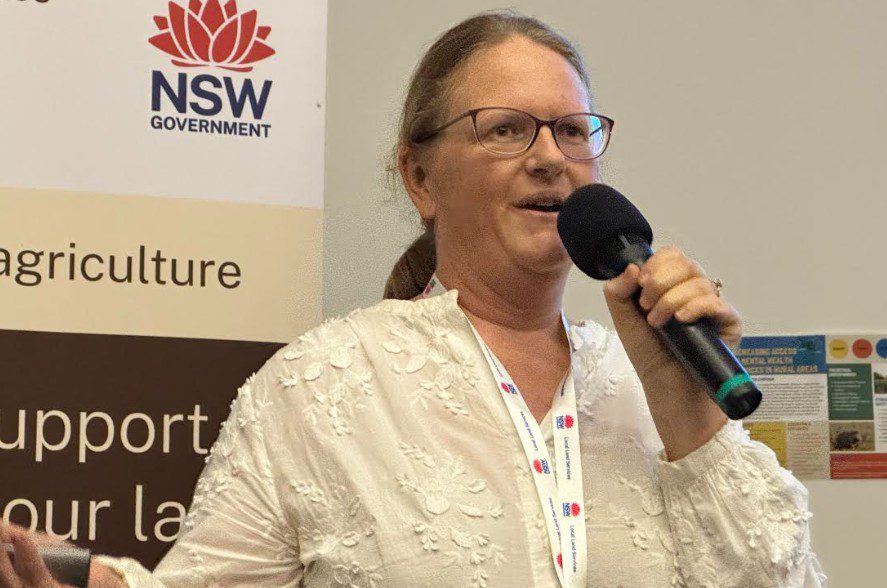
Gundagai Meat Processors’ supply chain manager Michelle Henry.
GUNDAGAI Lamb will next week outline its solution to the industry’s Achille’s heel – the ability to hook track lambs to provide individual carcase weight, eating quality and health feedback to producers.
At a hands-on workshop in the Coolac Hall on 24 March from 8.30am-1pm, Gundagai Lamb and the NSW Department of Primary Industries and Regional Development will show producers how can turn carcase feedback into practical profit-driving decisions on farm.
Producers will learn how to connect their processor data with what’s happening in the paddock and use electronic ear tags (EIDS) with purpose.
GMP will be the first Australian processor to successfully link individual lamb electronic identification to carcases at chain speed and provide full carcase eating quality and health condition feedback to producers. Gundagai Lamb has been providing individual carcase feedback including HSCW, LMY, IMF since 2021, and from March 2026 will enhance this individual carcase feedback by linking it to on-farm EID tags.
Gundagai Meat Processors supply chain manager Michelle Henry said Gundagai Lamb will be releasing a full suite of carcase feedback to producers from Tuesday the 24th of March.
She said this feedback will include the current individual objective carcase measurement feedback that Gundagai lamb have been providing producers with for some time, plus new information from EID tag numbers linked to each individual carcase.
“We have been working on this project for some time and as such we are very excited to be finally releasing the next level of feedback.”
DPIRD project manager Tracy Lamb will outline progress on a research project on getting EIDs working in meat processing plants in NSW and Sally Martin from SheepMetrix will present on using EID.
Gundagai Lamb is also developing an ability for producers to compare the feedback of different lots and a new functionality to give insights into the cost of animal disease and health issues, and carcase defects.
Registrations close for the workshop today.
Hook tracking is lamb industry’s Achilles’ heel
UNE meat scientist Prof Peter McGilchrist
In describing the consumer value of differentiating lamb carcases on eating quality at the first Southern Beef and Lamb School, University of New England meat scientist Prof. Peter McGilchrist said hook tracking to enable data feedback to producers is the Achilles’ heel of the sheep industry.
Prof. McGilchrist said Gundagai Meat Processors is the only plant currently able to hook track individual lambs and offer complete carcase feedback to producers.
He said other plants are looking at other technology to enable hoof tracking, such as QR codes, rather than EID or Radio Frequency Identyification (RFID) tags, or other visual systems that don’t suffer from radio signal interference.
“Hopefully that is successful and they will share that with everyone when they get it sorted, but at this point in time it’s just not happening.”
Prof McGilchrist said at this point in time most producers only receive weight and a tissue depth measurement feedback on their lambs. But he said full eating quality trait feedback will allow producers’ competitive natures to improve their sheep through selection.
“But it also might bring in more young people into our industry because there is something there to sink your teeth into and improve.”
Prof McGilchrist said providing full eating quality and carcase feedback to producers would enable the lamb industry to shift the value distribution of production up the scale.
“The beef industry has seen this in terms of quality, MSA feedback has shifted that year by year.
“If we get information we can increase selection pressure on our ewe or ram flock then we’re aiming for better lambs next year.”
Prof McGilchrist said at the moment not all lamb processors either don’t have the ability, or haven’t seen the benefit of hook tracking to put enough investment into it.
“That is the single thing that is holding that back.”
“Some of them want to understand what the volume would be across seasons and years before they say this is what our brand is going to be, and that’s OK, it’s a business decision,” he said.
“What you don’t want to be is stuck with higher quality meat and sell it at a lower price.”
He said hook tracking would help that brand development process for processors.
The four-day inaugural Southern Beef and Lamb School at the Charles Sturt University campus at Wagga Wagga was an initiative of Riverina Local Land Services.