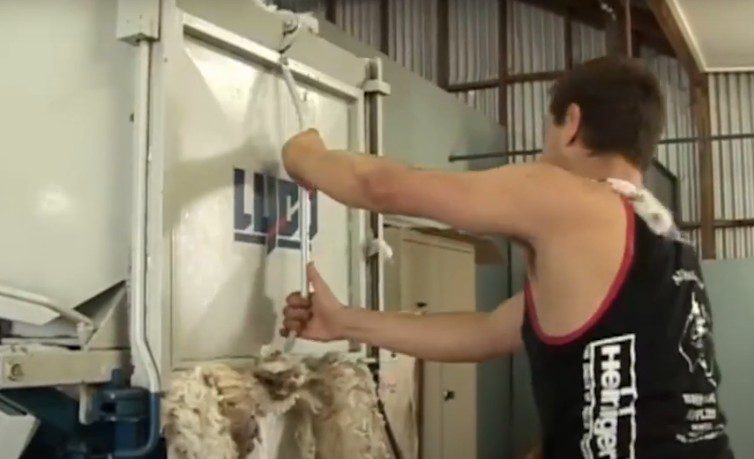
Using a safety door on a Lyco wool press. Source – AWI Youtube.
EMPLOYERS responsible for a worker killed by an unsafe wool press could face jail terms in the future, according to a national shearing contractor leader.
WorkSafe WA has advised that a Katrine farm owner has been fined $22,000 and $4861 in costs over unsafe controls on a wool press.
Wayne Bradley Ashworth pleaded guilty to failing to provide and maintain a safe work environment and was fined in the Northam Magistrates Court on 24 February.
WorkSafe WA said in January 2022, a farm manager was using the wool press to compress fleeces into cubic wool packs.
He had just ejected a full wool pack from the machine when, by an unknown means, the press activated while his upper body was between the press plate and the body of the machine, resulting in a fatal neck injury. The prosecution did not allege that the machinery safety issue caused the fatality.
 WorkSafe WA said at the time of the incident, the wool press was more than 30 years old and did not have controls installed that required the use of both hands to protect against the risk of inadvertent activation by the operator. When the press plate was in its fully raised position, the unguarded area between the press plate and the body of the wool press (the pinch point) was exposed to the operator.
Shearing Contractors Association of Australian secretary Jason Letchford said the incident is another tragedy for the ag sector “and it reminds us all, of the many dangers present in the agricultural work environments.”
He said WorkSafe work regulations in each state make it very clear, that every employer, including farmers, need to ensure that their work places are safe “and expect that where it is reasonable and practicable to engineer-out hazards, this has to be done, but was not done in this tragic situation.”
“Given the fact that there are now (Category 3) wool presses on the market that are all but impossible to injure, let alone kill the operator, these are now becoming the expected ‘standard’ for wool presses across that country.
“Therefore, in the future, any employer who is responsible for a worker being killed by a wool press, is highly likely to be facing much harsher penalties, including a gaol sentence, given the industrial manslaughter laws that have been operating in most States for several years now,” he said.
It’s a wake-up call
WA Shearing Industry Association president Darren Spencer said the death of the WA farm worker operating an old wool press is a wake call to anyone using unsafe equipment.
“As far as old wool presses in sheds go, I would only encourage growers to not let anyone use them.
“If a contractor goes into a shed with a wool press that has no safety features they should refuse to use it,” he said.
“My thought is they should be in the scrap heap or made unusable.
“It doesn’t matter how experienced a presser is accidents can still happen and with the wool press in this case it has a 15 second cycle,” Mr Spencer said.
“That means it takes less than seven seconds from hitting the lever for the platen/monkey to go past the pinch point.
“If anyone is still using a wool press that doesn’t have safety features then they should ask themselves why take the risk,” he said.
Mr Spencer said with the decline in sheep numbers there are plenty of wool presses with the latest safety features on the market and a new press with all the safety features is not that dear over its lifetime.
“This should be a wakeup call to anyone who is using a wool press without safety features.”
Mr Spencer believed the press involved in the fatality was a corner pinner.
“As a minimum safety a press should have a manufacturer safety bar that reverses the direction of platen/monkey.”
He said some manufacturers make wool presses that have exclusion doors on their wool presses that made it impossible for someone to get their arms or body parts into the pressing box.
“I have seen where pressers disable the exclusion doors and safety bars which should mean one warning and then instant dismissal.
“It’s the contractor or wool grower who wears the enquiry and legal burden of any injuries or fatalities should one occur.”
WorkSafe WA Commissioner Sally North said the risks of a person being caught in machinery must be identified and controlled.
“The wool press involved in this incident exposed the operator to the risk of having a body part crushed, with the added hazard of the emergency stop controls placed out of reach.
“This case presents an important reminder to all workplaces with machinery of the importance of checking that controls meet contemporary standards,” Ms North said.
WorkSafe WA is part of the Department of Local Government, Industry Regulation and Safety, that has a code of practice “Safeguarding of machinery and plant” available on its website outlining the hazards associated with machinery and practical ways to comply with work health and safety laws.