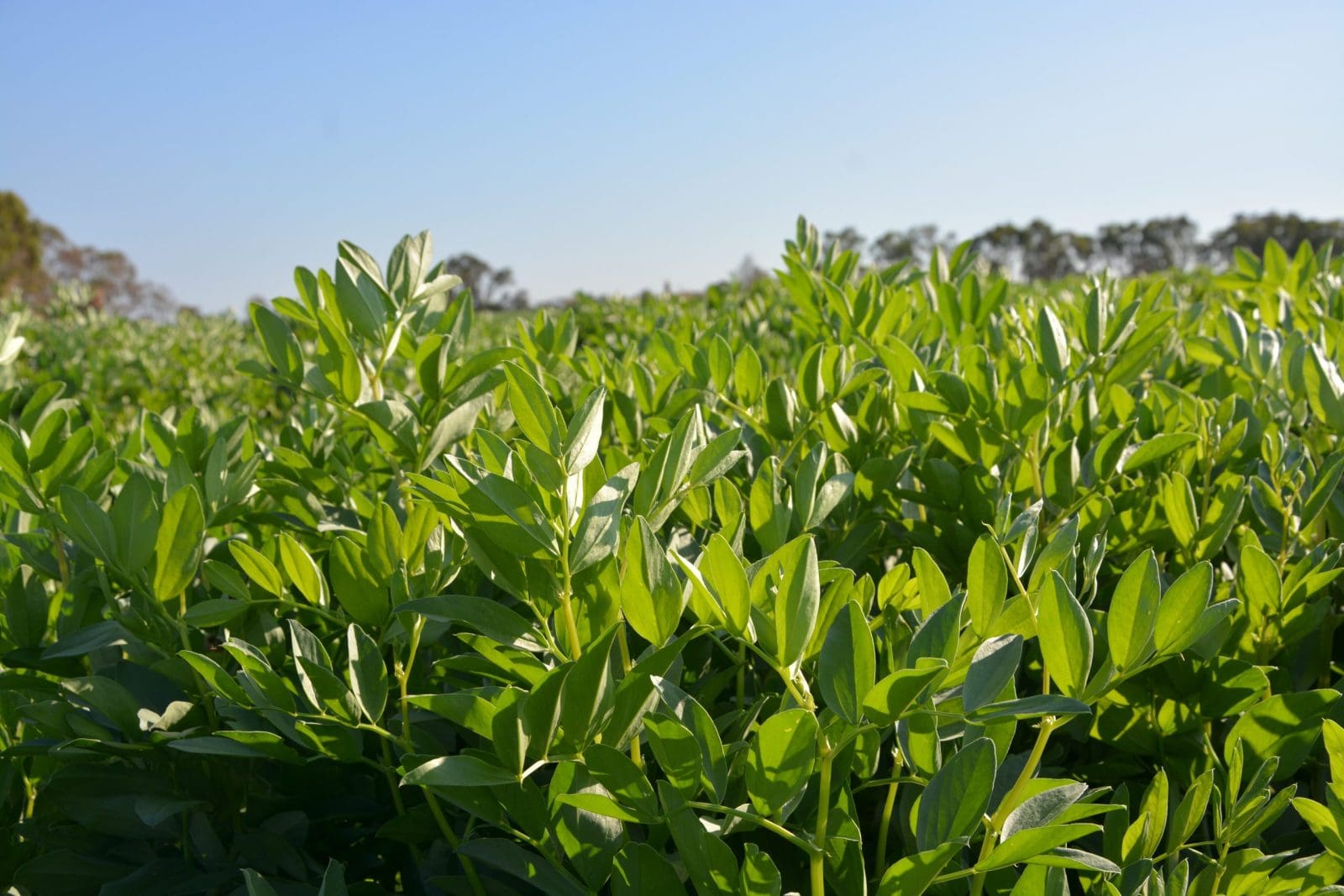
A crop of irrigated faba beans.
LEADING Australian seed company InterGrain has secured the contract for the Grain Research and Development Corporation’s faba bean breeding program in partnership with the University of Adelaide.
A contract notice published on the Australian Government’s AusTender website revealed InterGrain as the supplier of the $3.75 million Collaboration Agreement Faba Bean Breeding Program tender.
The contract commenced on Friday and will run until 30 June 2028.
GRDC opened the tender on 23 August 2024, and closed it just over one month later.
Titled EOI Faba Bean Breeding Program – Stage 1, the opportunity invited “potential collaborative partners and co-investors to join the next phases of the faba bean breeding program with GRDC and the University of Adelaide”.
“This is an exceptional opportunity to shape the future of the Australian faba bean breeding program and deliver tangible benefits to Australian grain growers,” the approach to market said.
The EOI stated applicants should be an existing commercial breeding company or breeding consortium.
In an announcement released alongside the EOI, GRDC stated it would be pursuing a “renewed approach to its national Faba Bean Breeding Program”.
“Under a new three-year investment set to begin in 2025, GRDC’s current Faba Bean Breeding Program, run in partnership with the University of Adelaide, will be consolidated to support more efficient faba bean breeding activities,” the announcement said.
“The new program will be responsible for developing varieties suitable for Victoria, SA, northern NSW and southern Qld, as well as expansion into new production areas.
“The program will also be required to diversify the range of varieties available for growers and various end-users.”
InterGrain pulse interest
Headquartered in the Perth suburb of Bibra Lake, InterGrain currently breeds varieties of wheat, barley and oats.
The company is 58 percent owned by the Western Australian Government, with GRDC holding the balance.
While InterGrain has not yet released a pulse variety, it has expressed interest in entering the sector, particularly via faba beans.
Mid-2025, the company completed work on its new Horsham facility in Victoria’s Wimmera region, where faba beans are widely grown.
InterGrain also has an operation co-located with the NSW Department of Primary Industries and Regional Development at Narrabri.
Both sites are among the four target areas identified by the GRDC for its updated faba bean program.
Last year, InterGrain chief executive Tress Walmsley told Grain Central the company was exploring expansion into new crop types and growing regions.
“These new facilities will enable us to diversify into some other crops,” Ms Walmsley said.
“We’re having a pretty good look at faba beans and other pulses as well.”
FBA background
The previous program, known as Faba Bean Breeding Australia (FBA), was led by the University of Adelaide in partnership with the GRDC, with support from the University of Sydney, SARDI, the NSW Department of Primary Industries and the former Pulse Australia.
The University of Sydney’s Plant Breeding Institute website says it hosts the northern arm of the faba bean breeding program.
According to GRDC’s website, funding for this investment began in July 2016 and finished in December 2025.
The work targeted traits from heat, frost, and resistance to a number of fungal and viral diseases including ascochyta blight, rust, chocolate spot, Cercospora leaf spot, bean leaf-roll virus, and bean yellow mosaic virus.
The University of Adelaide is listed as the variety owner of seven of the eight faba bean varieties subject to end-point royalties.
ABARES estimates Australia produced 1.02 million tonnes of faba beans in 2025-26 from 441,000 hectares, up from 750,000t over 401,000ha in the previous year.
Australia is a leading exporter of faba beans globally, accounting for about one-third of international trade.
About 75pc of its exports are shipped to Egypt, with a further 15pc going to markets across the Middle East and North Africa, and servicing expanded demand in South-east Asia.
GRDC was contacted for comment.
Grain Central: Get our free news straight to your inbox – Click here