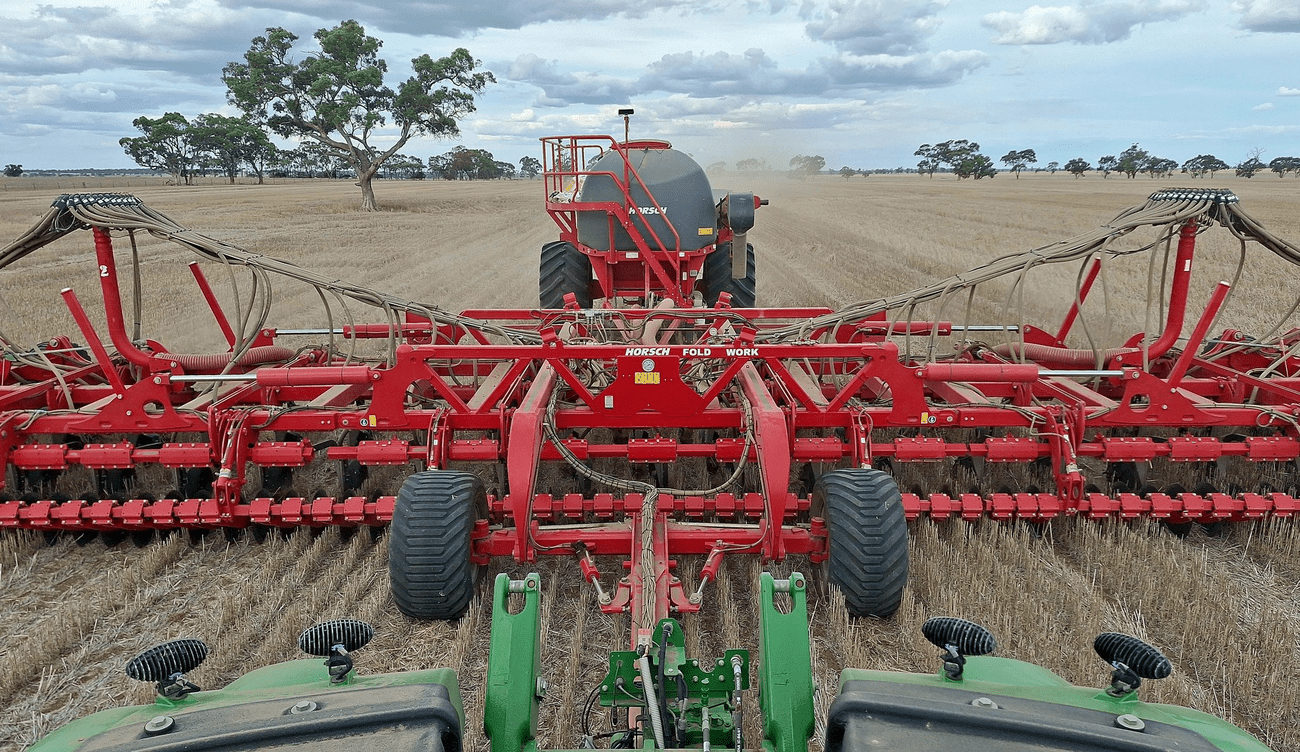
Growers are sowing dry at maximum pace ahead of rain forecast for SA, Vic and southern NSW into next week. Photo: Jonathan Dyer, Kaniva, Vic
LIMITED prospects for a widespread winter-crop planting in northern New South Wales and southern Queensland have further lifted barley values this week.
However, wheat at port has softened as chatter builds around the bringing in of South or Western Australian grain to supply coastal consumers.
At least 10mm of rain is forecast into next week for the South Australian and Victorian grainbelt, and central and southern NSW.
This is consolidating prospects for the winter crop now being planted in the south as dry in the north continues to fuel bids from up-country consumers.
| Apr 23 | Today | |
| Downs barley | $440 | $442 |
| Downs SFW | $440 | $434 |
| Downs sorghum | $355 | $375 |
| Mel barley | $348 | $345 |
| Mel ASW | $370 | $365 |
Table 1: Indicative prices in Australian dollars per tonne.
North moves mixed
Wheat prices have softened in the north in the past week as speculation mounts that at least one shipment will land in Brisbane in coming weeks to shore up demand from consumers close to port.
“The poultry guys in Brisbane just want to lock something up,” one trader said.
Poultry mills in the Greater Brisbane area have in recent weeks lifted the proportion of sorghum in their rations to full inclusion, or close to it, to reflect sorghum’s significant discount to white grains.
The move has pulled back volume available to China ahead of the Central Qld sorghum harvest expected to kick off late next month.
Truckloads of barley from central NSW are making their way to feedlots and graziers in southern Qld and northern NSW, including the New England.
 “The New England is basically doing what they did back in 2020; getting rid of cattle and building up a bit of a reserve of feed for winter,” a NSW trader said.
The New England’s sheep producers are also looking for feed.
“The New England’s looking for roughage and protein.
“Sheep guys are going for fabas, lupins and corn, but corn’s gotten too expensive.
“The cattle guys are going for the same, and a bit more grain.”
Based on dry conditions in the north, cottonseed values have risen by around $100/t over recent weeks, and now sit at around $580-$600/t delivered Downs.
“At those sort of values, canola meal is better value for the feedlots,” Australian Country Choice commodities manager Brad Taylor said.
Canola meal is trading at around $640/t delivered Downs.
“It works better in the rations than cottonseed.
“It’s really only people who have very low roughage coverage, or drought feeders, that are using cottonseed at these values.”
In the Macquarie Valley, barley is trading at around $370/t ex farm, with wheat at more like $360/t, while faba beans are finding some demand at $470/t.
In his market comment released on Monday, Clear Grain Exchange managing director Nathan Cattle said at current price differences across states, grain is able to flow into north-eastern Australia.
“These price spreads are likely to remain until wetter conditions provide some relief and certainty over supply in the north-east,” Mr Cattle said in his report.
“Strong demand for grains and a high number of buyers trying to purchase grains remains, and is likely to remain until conditions improve, though the lift in grain prices led by a drying north-eastern Australia has run most, if not all, of its course.
“Grain prices around Australia are generally trading at full execution cost into north-eastern Australia currently.”
Planting accelerates in south
Growers from around Grenfell south are tearing into dry sowing ahead of rain forecast for coming days which will wet topsoil and get crops up and away in paddocks with good subsoil moisture.
“There’s no doubt the north is dictating the market,” Peters Commodities Wagga Wagga-based trader Peter Gerhardy said.
“As the dry comes down, it’s bringing the market south, and prices are slowly but surely going up.”
At Young, Grain Focus managing director Michael Jones said planting of canola was close to complete, and dual-purpose and grazing crops were “in and up”.
Depending on how much rain falls in coming days, growers will then make decisions about main-season wheat, which is ideally planted in mid to late May.
“It’s all about the weather,” Mr Jones said.
Feed demand is lifting the market for lower grades of wheat, and spreads are already compressed.
“Prime Hard is around $5 above H2; if we miss this rain, it’ll all be the same.”
Wheat is trading at around $370-$380/t delivered Griffith, while barley ex farm on the south-west slopes is trading at around $340-$360/t.
“The further north it is, the more you get for it.”
Any barley offered as far south as the Vic border appears to be getting snapped up by consumers.
Faba beans are finding modest demand at around $430-$440/t ex farms.