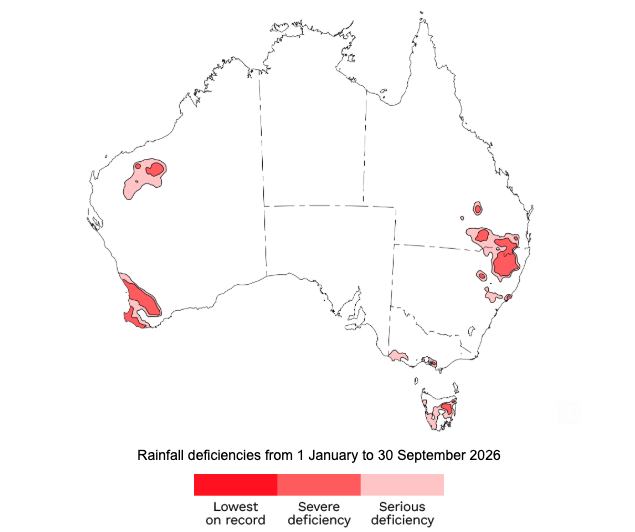
SEPTEMBER rainfall was very much below average in the far west and across much of eastern Australia, but very much above average in western inland areas, according to the Bureau of Meteorology’s latest monthly drought statement issued today.
As the above map shows, areas with 2026-to-date rainfall deficiencies expanded in:
- the west of Western Australia
- southern Queensland
- north-eastern New South Wales and Tasmania
- developed in parts of southern Victoria.
Areas with 24-month rainfall deficiencies expanded and intensified in southern Victoria and Tasmania and persisted in the south-west of Western Australia.
Long-range forecasts for 4-month rainfall deficiencies to the end of October, show deficiencies are very likely to persist through the month for south-west Western Australia. Deficiencies are likely to persist for parts of southern Victoria, eastern Tasmania and coastal southern Queensland, while forecast 9-month deficiencies are likely to persist to the end of December in these southern areas, but contract in Queensland.
Below-average soil moisture intensified across eastern Queensland, while strengthening along the coastal and adjacent ranges of New South Wales and Victoria, in addition to persisting through the south-west of Western Australia.
Evaporative stress increased across south-eastern Australia, becoming more widespread through New South Wales and Victoria, while remaining elevated across Queensland, Tasmania, and parts of Western Australia.
Streamflow was lower than average at many sites across southern Queensland, norther New South Wales, Victoria and the south-west of Western Australia.
Some water storages in the eastern and southern states are at or below 50% of their capacity.
Groundwater levels were below average and persist across parts of southern Australia.
Source: BOM